
Veterinary PIMS: what it is, what it costs and how to choose one
A practice information management system runs the whole clinic: the record, the schedule, the invoice and the stock. Here is what a modern PIMS should do, who sells them, what they cost in 2026, how a switch really goes, and the questions to put in writing before you sign, including the ones you should put to us.
12 minute read · updated October 14, 2026 · every number is sourced at the end
Reviewed by Dr. Rajbir Grewal, DVM, a practicing veterinarian and partner in Bittsi
How we checked: every figure links to its source, and each price is the vendor's own published page, read in October 2026. Bittsi makes a PIMS; where the same question applies to us, this guide gives our answer.
- A veterinary PIMS is the software a clinic runs on: the medical record, scheduling, estimates and invoices, payments, inventory and client reminders.
- Published 2026 prices run from about $123 to more than $300 a month, before setup, migration and add-ons.
- Practitioners describe six to twelve months from first thought to go-live when they switch; the product list and the receivables are where data breaks.
- Read the exit clause first: no law requires a vendor to hand your data back in a standard format.
In this guide · 10 sections
- 01What is a veterinary PIMS?
- 02What should a modern PIMS do?
- 03Who makes veterinary PIMS software?
- 04Cloud PIMS or server-based PIMS?
- 05How much does a veterinary PIMS cost?
- 06How to switch to a new veterinary PIMS
- 07Your data and the exit clause
- 08AI in a PIMS, honestly
- 09The questions to ask in writing
- 10Where Bittsi fits
What is a veterinary PIMS?
A veterinary PIMS (practice information management system) is the software a clinic runs on. It holds the medical record, books appointments, builds estimates and invoices, takes payments, tracks inventory and sends client reminders. Veterinary practice management software, a PMS and vet software are other names for the same thing; a veterinary EMR is usually the clinical part of a PIMS.
Three quarters of US practices already have one: the AVMA puts it at 76.5 percent, with 59.9 percent using client communication software that connects to it.[1] For most clinics the question is not whether to have a PIMS, but whether the one you have still fits the way you practice.
- Scheduling and reminders
- Estimates and invoices
- Payments
- Inventory and drug logs
- Lab and imaging results
- Treatment and anesthesia sheets
- Client messages
- Reports
What should a modern PIMS do?
A PIMS used to mean records and billing on a server in the back office. Today the job runs from the front desk to the treatment area.
Medical records and SOAP notes
SOAP notes, problem lists, vaccines and prescriptions, with templates that fit the way your doctors write and a record every other part of the system reads from.
Scheduling and online booking
Appointment types, reminders that carry a booking link, and online booking on your website and your Google profile. The AVMA names online scheduling and automated reminders as the first automation a practice should adopt, yet only a third of practices offer online booking.[1]
Estimates, invoicing and payments
Estimates the client approves before the work, invoices that build themselves from the record, and card payments that post to the invoice.
Inventory and controlled-drug logs
Stock that comes off the shelf as it is charged, controlled-drug logs and purchasing.
Lab and imaging integrations
Reference-lab and in-house analyzer orders from the record, with results landing on the visit. Ask which labs and analyzers connect, in both directions.
Treatment sheets, anesthesia records and dental charts
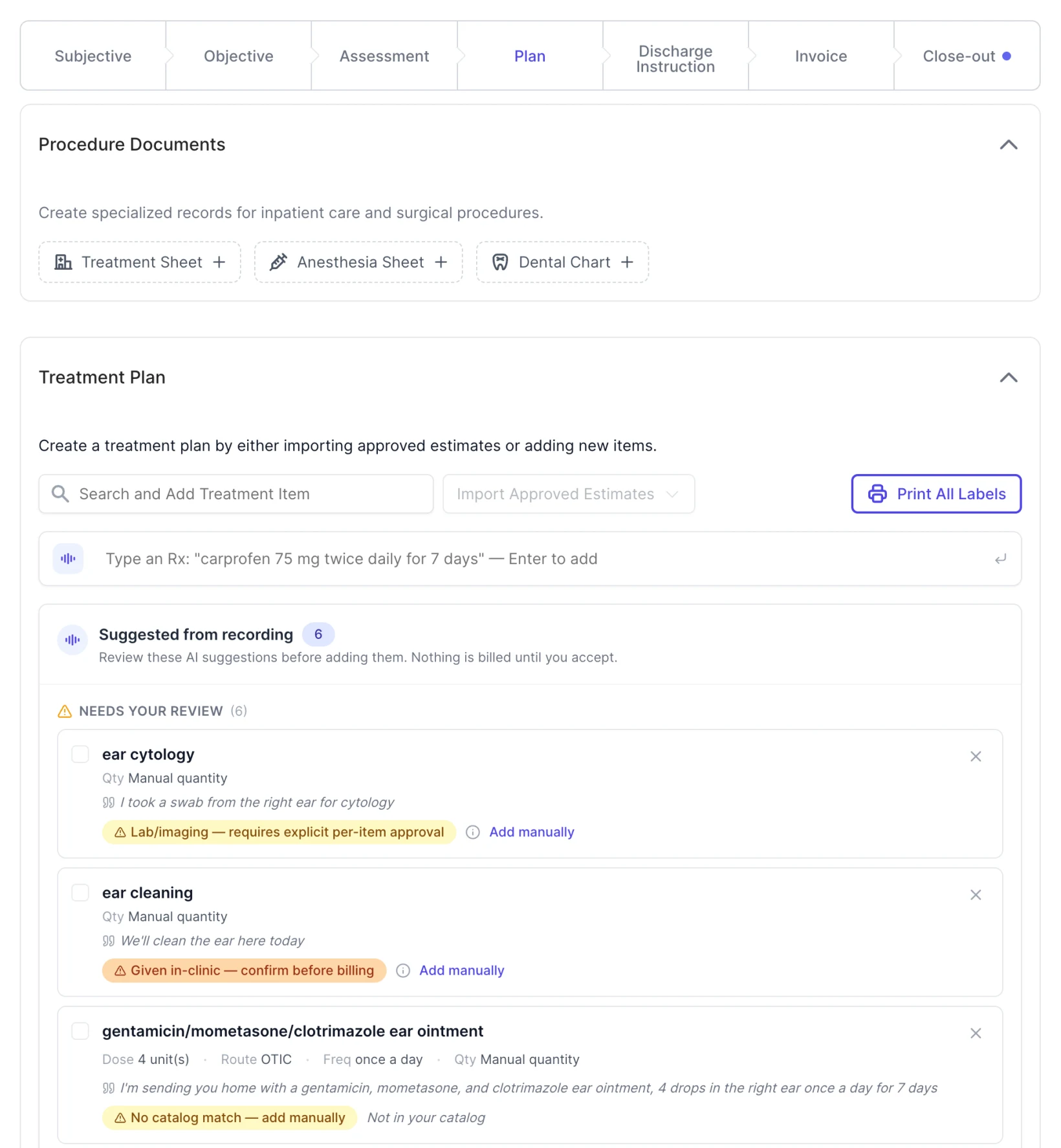
The hospital floor in the same system as the record, so a hospitalized patient is never on paper: treatment sheets, anesthesia records and dental charts.
Client communication and reminders
Two-way texting, with reminders and replies that land in the chart.
Reports
Revenue, compliance and who came back, from the data already in the system.
A good test of any PIMS: in the demo, ask to watch a client book, get reminded, come in and pay, end to end.
Who makes veterinary PIMS software?
The market is more concentrated than the logos suggest, and several of the largest PIMS vendors are diagnostics or distribution companies first. IDEXX owns four systems: the cloud products ezyVet, Animana and IDEXX Neo, and the on-premises Cornerstone;[4] its cloud platforms passed 10,000 locations in 2025.[2] Covetrus, behind AVImark and ImproMed, has been private since 2022[5] and in February 2026 announced a merger with MWI Animal Health that still awaits regulatory approval.[6] Mars, which owns Antech, counts practice information management software within its diagnostics business,[7] and Chewy bought the maker of the Rhapsody system in 2022.[8]
Around them sit independents: Provet, part of Nordhealth,[16] Digitail, which raised $23 million in 2025,[24] Shepherd, Instinct, Vetspire, VETport, Onward, DaySmart and others, and newer entrants such as Bittsi.
| System | Owner |
|---|---|
| ezyVet | IDEXX |
| Animana | IDEXX |
| IDEXX Neo | IDEXX |
| Cornerstone | IDEXX |
| AVImark | Covetrus |
| ImproMed | Covetrus |
| Rhapsody | Chewy |
| Provet Cloud | Nordhealth |
| Digitail | Independent |
| Bittsi | Independent |
Nobody publishes a current market share. The last cross-vendor table in the US trade press listed 25 products in 2021, with figures the companies supplied themselves.[9] What you can check is who owns the vendor, because that decides what else they would like to sell you: an analyzer and testing commitment,[10] a distribution account or a payments contract.
Cloud PIMS or server-based PIMS?
A server-based PIMS lives on a computer in the clinic; a cloud-based PIMS runs in the vendor's data centers and opens in a browser. The direction is settled: the largest vendor reports that two thirds of its installed base is now cloud.[11] For most clinics cloud is the default: no server to buy, back up or replace, access from home and from a phone, and updates without a site visit. What you owe in return is a reliable connection. One cloud vendor asks small practices for at least 20 Mbps and a wired network for the workstations that matter.[12] Budget a second internet line; it costs less than a day without charts.
How much does a veterinary PIMS cost?
Published 2026 prices start around $123 a month and run past $300, and the way they are counted varies: flat per clinic, per veterinarian with a platform fee, or not published at all.
| Vendor | Published entry price |
|---|---|
| DaySmart Vet | from $123/mo |
| ezyVet | from $260.50/mo |
| Onward | from $300/mo |
| Provet | $99/vet + $249/mo |
| Bittsi Foundation | $249/mo |
| Bittsi Standard | $379/mo |
| Standard with Bittsi Pay | $249/mo |
The prices above are each vendor's own published entry price: DaySmart,[13] ezyVet, with a six-month initial term,[14] Onward[15] and Provet, $99 per veterinarian plus a $249 platform fee.[16] The sticker is the smaller part of the decision. Implementation and data conversion are often priced separately, as ezyVet lists them;[14] migration fees in the 2021 survey ran from free to $8,000;[9] AI scribes are usually a per-seat add-on, $40 a seat at Provet;[16] and card processing carries its own rate. Price the whole first year: subscription, setup, conversion, training, add-ons, processing, and the hardware a cloud system still needs.
How to switch to a new veterinary PIMS
Most buyers are not choosing their first PIMS; they are leaving one. Practitioners who have done it describe six to twelve months from first thought to go-live, about 40 hours of training, and a stretch when every task takes three times as long.[3] Vendors quote implementation in weeks (Provet says most practices are live in 8 to 12),[16] and the difference between the two numbers is the clinic's own work: cleaning the product list, rebuilding the fee schedule and retraining the team.
The data is where switches go wrong. There is no standard format for veterinary practice data, and the fields that break most often are the product list and the accounts receivable.[17] Before you sign, get in writing exactly what moves (clients, patients, visit history, prescriptions, vaccines, balances and documents), who checks it, and what it costs.
- Run the trial with your own data loaded, not the demo clinic.
- Get the migration scope and price in writing.
- Clean the fee schedule and product list before the conversion, then freeze them.
- Train in short blocks by role, and plan a lighter schedule for go-live week.
- Keep read access to the old system until the balances reconcile.
Your data and the exit clause
The medical record belongs to the practice: AVMA policy says so, and state law sets how long it must be kept.[18] Whether your vendor hands the data back in a usable form is a different matter, decided by contract, not law: companies are not obligated to provide practice data in a standard format.[17] Read the exit clause before the feature list: the export format, how long it takes, what it costs, and whether the product list and the receivables come with it.
AI in a PIMS, honestly
AI arrived in practice software through the exam room. A survey of 3,968 veterinary professionals found 39.2 percent using AI tools,[19] and a 2026 peer-reviewed survey of internal-medicine specialists found 42 percent in the US, with AI scribes among the most common tools.[20] The same study reports no figure for time saved, and no other peer-reviewed veterinary source does either, so treat every minutes-saved claim, ours included, as something to test in your own exam room.
What separates a scribe bolted onto a PIMS from AI inside one is where the output goes. A note that lands in the record, a drug checked against the patient before it is given, a draft estimate waiting in a queue for a person to approve: each needs the AI and the record to be one system. The state boards ask licensees to understand AI's limits, be transparent about its use, protect client data and get consent when appropriate,[21] so ask any vendor where the audio goes, how long it is kept, what the AI is allowed to decide, and who signs the note.
The questions to ask in writing
AAHA's own checklist names six factors: ease of use, customization, integration, mobile access, customer support and pricing structure.[22] Turn them into questions with written answers:
- Term and renewal. The minimum term, how it renews, and the notice a price increase requires.
- Exit. The export format, timing and cost, including the product list and the receivables.
- Dependencies. Whether the price depends on a lab commitment, a processor or an add-on.
- Integrations. Which reference labs and analyzers connect,[23] in both directions, at what fee.
- Migration. What moves, who checks it, and the price, before you sign.
- Implementation. Weeks to go-live, hours of training, and who builds the catalog and the templates.
- Support. The hours, the channel, and who answers: a queue or a person.
- AI and data. Where audio and records are stored, for how long, and who signs what the AI drafts.
Where Bittsi fits
Bittsi is one system from the front desk to the hospital floor: the record and SOAP notes, scheduling and reminders, estimates and invoices, inventory, client texting and payments, with the treatment sheet, anesthesia sheet and dental chart on Standard. The AI sits in the record, not beside it. The price is published, plans are month to month, staff users are free, and your data leaves with you whenever you ask. If that fits how you practice, see it with your own data: we load a sandbox before you commit.
Questions people ask about a PIMS
What does PIMS stand for in veterinary medicine?
Practice information management system: the software a clinic uses to run its medical records, scheduling, estimates and invoices, payments, inventory and client communication. PIMS and practice management software mean the same thing.
What is the difference between a PIMS, a PMS and an EMR?
PIMS and PMS are two names for the same software: a practice information management system and a practice management system. An EMR, the electronic medical record, holds the clinical record; in veterinary medicine it is usually one part of the PIMS, which also runs appointments, estimates, invoices, payments, stock and reminders.
How much does a veterinary PIMS cost?
Published 2026 prices run from about $123 to more than $300 a month, counted per clinic or per veterinarian, and several vendors publish no price at all. Implementation, data conversion, AI add-ons and card processing are often extra. Bittsi's Foundation plan is $249 a month and Standard is $379, or $249 for clinics that make Bittsi Pay their primary processor (a minimum processing volume applies).
How long does it take to switch to a new PIMS?
Vendors quote implementation in weeks; one says most practices are live in 8 to 12. Practitioners who have switched describe six to twelve months from first thought to go-live, including cleanup and about 40 hours of training. The product list and the receivables are the data most likely to break in a conversion, so check them first.
Is a cloud PIMS better than a server-based one?
For most clinics, yes: no server to buy or back up, access from home and from a phone, and updates without a site visit. In return you need a reliable connection, at least 20 Mbps and a wired network for the main workstations, and ideally a second line.
Can I get my data out of my PIMS if I leave?
The records belong to the practice, but no law requires a vendor to export them in a standard format; your contract decides that, so read the exit clause before you sign. Bittsi exports your complete records in standard formats whenever you ask.
What is the best veterinary PIMS?
There is no neutral ranking: the 2026 lists are published by vendors, this guide included. Judge a shortlist on four written answers: the first-year cost, what the migration moves, which labs connect, and the exit clause. Bittsi publishes all four on this page, and loads a sandbox with your own data so you can test them.
Sources
- [1]2025 AVMA Report on the Economic State of the Veterinary Profession, American Veterinary Medical Association, 2025.
- [2]Third quarter 2025 prepared remarks, IDEXX Laboratories, 2025.
- [3]Switching up your veterinary practice software, dvm360, 2013.
- [4]Form 10-K, fiscal year 2025, IDEXX Laboratories, via SEC EDGAR, 2026.
- [5]Covetrus to be acquired by CD&R and TPG, Clayton, Dubilier & Rice, 2022.
- [6]Cencora Form 8-K, exhibit 99.1, Cencora, via SEC EDGAR, 2026.
- [7]Mars completes acquisition of Cerba Vet and Antagene, Antech Diagnostics, 2024.
- [8]Form 10-Q, quarter ended April 30, 2023, Chewy, Inc., via SEC EDGAR, 2023.
- [9]Who's who in veterinary practice management software, Today's Veterinary Business, 2021.
- [10]IDEXX 360, IDEXX Laboratories, 2026.
- [11]Investor Day 2025, slide 128, IDEXX Laboratories, 2025.
- [12]Get your IT system ready for the cloud, ezyVet (IDEXX), 2023.
- [13]Pricing, DaySmart Vet, 2026.
- [14]Pricing for the United States, ezyVet (IDEXX), 2026.
- [15]Pricing, Onward Vet, 2026.
- [16]Pricing, Provet (Nordhealth), 2026.
- [17]Burr in the side of practice management software, VIN News Service, 2024.
- [18]Principles of Veterinary Medical Ethics of the AVMA, American Veterinary Medical Association, 2025.
- [19]39.2% of veterinary professionals use AI tools in their practice, Digitail and AAHA survey, via PR Newswire, 2024.
- [20]Use of, and attitudes toward, artificial intelligence in members of the ACVIM and ECVIM, Journal of Veterinary Internal Medicine, 2026.
- [21]AAVSB releases considerations for the use of AI in veterinary medicine, American Association of Veterinary State Boards, 2025.
- [22]Considerations for choosing veterinary practice management software, AAHA Trends, 2026.
- [23]Practice management integration resources, IDEXX Laboratories, 2026.
- [24]Digitail raises $23M Series B, Digitail, via PR Newswire, 2025.
Changes
- October 14, 2026 · First published.
See your own clinic in Bittsi.
We load a sandbox with your own data before you commit, so you judge the system on your records, your fee schedule and your team, not on a demo clinic.