The Hidden Cost of Legacy Veterinary Software
Many veterinary clinics continue to rely on legacy Practice Information Management Systems (PIMS) simply because they are busy. The daily rhythm of patient care—appointments, emergencies, phone calls, prescriptions, and administrative work—leaves little time to step back and evaluate the tools that power the clinic. When everything feels urgent, replacing software rarely becomes a priority.
However, the reality is that outdated systems often carry hidden costs that accumulate every single day.
The Problem With Legacy Platforms
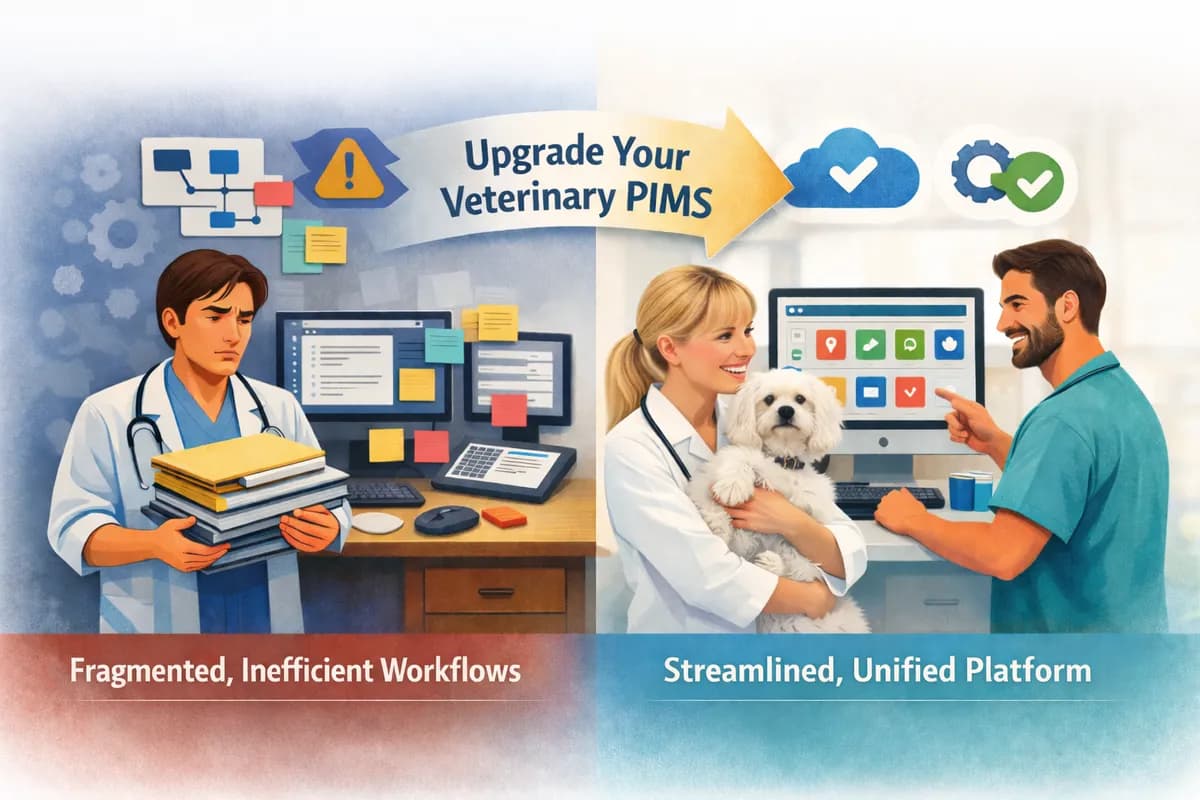
Legacy platforms were built for a different era of veterinary medicine. Many were designed before cloud infrastructure, automation, integrated communications, and modern data workflows became standard. Over time, clinics using these systems often develop fragmented workarounds to compensate for limitations.
Instead of a single smooth workflow, staff may rely on a patchwork of disconnected tools. A receptionist may manage appointments in one system, while medical notes live in another. Billing may require exporting or manually transferring data. Communication with pet owners might depend on a completely separate messaging tool.
These fragmented workflows slow the clinic down. More importantly, they introduce risk.
When information must be transferred between systems manually, mistakes become more likely. A small error, such as a missed note, incorrect billing entry, or incomplete medical history, can ripple across the entire workflow. Staff spend valuable time correcting issues rather than focusing on patient care.
The true cost is not only financial. It also impacts efficiency, team morale, and ultimately the client experience.
Segregated Workflows Create Invisible Costs
Broken workflows rarely appear on a financial statement, but they show up in many other ways.
Staff members may spend extra minutes on every appointment because the system requires multiple steps to complete routine tasks. Over the course of a day, those minutes turn into hours.
Communication between team members becomes slower because information is scattered. Doctors may struggle to quickly access the full patient history. Technicians may have to search through different modules or screens to find critical details.
Meanwhile, administrative staff may need to double-check information constantly to ensure accuracy.
These inefficiencies compound over time.
What seems like “the way things have always been done” may actually be costing the clinic thousands of dollars per year in lost productivity and preventable mistakes.
Why Exploring New PIMS Matters
Shopping for a modern PIMS is not simply about replacing old software. It is an opportunity to rethink how the clinic operates. The veterinary technology market has evolved significantly. New systems are being designed around automation, real-time collaboration, cloud access, and integrated workflows. Modern veterinary software platforms, such as Bittsi PIMS, are designed to unify clinical workflows and reduce operational friction. Exploring these platforms can give clinics valuable insight into where the industry is heading. Even if a clinic ultimately decides not to switch immediately, the process of evaluating new systems can reveal possibilities the team may not have considered before. Clinics often discover more efficient ways to handle appointment flow, documentation, billing, inventory management, and communication with clients. In other words, shopping for a PIMS is not just a software decision, it is a workflow discovery process.
Start With Your Clinic’s Pain Points
When evaluating new PIMS platforms, one of the most important steps is identifying your clinic’s key pain points.
Every clinic operates differently. Some struggle with appointment scheduling inefficiencies. Others face documentation bottlenecks or slow billing processes. Some clinics spend too much time managing inventory or coordinating communication with pet owners. Before comparing systems, take time to identify the three to five biggest challenges your team experiences on a daily basis.
Examples might include:
-
Too many manual steps in patient intake
-
Difficulty accessing complete patient history quickly
-
Billing errors caused by disconnected systems
-
Time-consuming medical documentation
-
Lack of automated communication with pet owners
Once these pain points are clearly defined, it becomes much easier to evaluate how different PIMS platforms approach solutions.
Not All PIMS Platforms Are the Same
One common mistake clinics make when evaluating software is assuming that all PIMS platforms function similarly.
In reality, modern systems often take very different approaches. Some platforms emphasize automation and AI-assisted documentation. Others focus heavily on communication tools such as automated reminders, messaging, and client engagement. Some systems prioritize workflow simplicity and speed, while others offer extensive customization. Because of these differences, the best platform for one clinic may not be the best choice for another.
The goal should not be to find the “most popular” or “most advanced” platform. Instead, clinics should look for a system whose design philosophy aligns with how their team works. A good PIMS should feel like a natural extension of the clinic’s workflow rather than something staff must constantly fight against.
Compatibility With Your Workflow
The most successful software transitions occur when the new system enhances existing workflows rather than forcing an entirely new process overnight.
This does not mean avoiding change, modern systems often introduce improvements that simplify operations. However, the transition should feel logical and supportive.
When evaluating platforms, clinics should ask questions such as:
-
Does this system reduce manual steps in our most common tasks?
-
Can our team access information faster than before?
-
Does the system integrate scheduling, documentation, billing, and communication smoothly?
-
Will this improve collaboration between doctors, technicians, and administrative staff?
If a platform meaningfully improves these areas, it is likely a strong candidate.
A Strategic Opportunity for Growth
Technology decisions can feel overwhelming, especially for clinics already operating at full capacity. But modernizing a PIMS should be viewed as an investment in the clinic’s future. Efficient workflows reduce staff stress, improve accuracy, and free up time that can be redirected toward patient care and client relationships. Over time, the improvements in productivity and error reduction can significantly outweigh the effort required to adopt a new system. Most importantly, evaluating modern tools allows clinics to stay aligned with the direction of the veterinary industry. As technology continues to evolve, clinics that proactively explore better systems position themselves to operate more efficiently, serve clients better, and grow sustainably.
How Modern Platforms Like Bittsi Are Addressing These Challenges
As veterinary medicine evolves, so does the technology that supports it. Many modern Practice Information Management Systems are being built from the ground up to solve the exact challenges that legacy platforms created over time. One example is Bittsi PIMS, a modern platform designed to unify clinical and operational workflows inside veterinary clinics. Instead of relying on multiple disconnected tools, modern platforms aim to bring essential clinic operations, such as scheduling, patient records, billing, communication, and documentation, into a single, cohesive system. When these components work together seamlessly, clinics can reduce administrative friction and minimize the risk of human error.
Bittsi focuses heavily on workflow clarity and operational efficiency. By simplifying how information moves between different parts of the clinic, teams can access patient data faster, coordinate care more easily, and spend less time navigating complicated software interfaces. Another important advantage of modern cloud-based platforms is their ability to evolve with the industry. Veterinary medicine is changing rapidly, with growing expectations for digital communication, automation, and data-driven decision making. Systems designed with modern architecture can adapt more easily to these changes, allowing clinics to adopt new capabilities without the limitations often imposed by legacy infrastructure.
For clinics exploring new PIMS options, evaluating platforms like Bittsi can provide valuable insight into how modern technology can streamline workflows, reduce operational stress for staff, and ultimately improve the overall client and patient experience.
Final Thoughts
Legacy systems often remain in place not because they are ideal, but because clinics are simply too busy to reconsider them.
Yet the cost of fragmented workflows, manual processes, and preventable errors accumulates every day. Exploring modern PIMS platforms offers more than a technology upgrade. It provides a chance to rethink workflows, identify inefficiencies, and discover tools designed for the realities of modern veterinary practice.
By focusing on your clinic’s top pain points and evaluating how different systems address them, you can find a platform that truly enhances the way your team works.
And in a profession where every minute matters, a better workflow can make all the difference.
Explore a Modern Approach to Veterinary Practice Management
If your clinic is evaluating alternatives to legacy systems, exploring modern PIMS platforms can be a valuable first step toward improving efficiency and reducing operational friction. Bittsi PIMS is designed to help veterinary teams streamline workflows, reduce administrative burden, and operate on a platform built for the future of veterinary care.
👉 Request a demo to learn more about Bittsi PIMS and see how modern workflow design can transform your clinic.