
Cloud-Based Veterinary Practice Management Software Guide
Most veterinary software just stores records. See what a true cloud-based PIMS does differently — AI, workflows, scaling, and how to choose right.

Cloud-Based Veterinary Practice Management Software: A Complete Guide for Modern Clinics
You can often tell how busy a clinic really is by looking at the end-of-day notes, not the appointment calendar. From the outside, a full schedule looks like the main pressure point. Inside, the real weight builds more quietly. It’s in the unfinished records, the half-documented consultations, and the mental notes veterinarians carry from one room to the next.
In many clinics, the last patient leaves on time, but the team doesn’t, because the documentation is still waiting. It’s not the appointments themselves that stretch the day. It’s everything that needs to be written down afterward.
This guide covers what modern cloud-based veterinary practice management software actually does, how to evaluate it, and how to choose the right platform for your clinic size and specialty. If you’re actively comparing platforms right now, see the full comparison of the top veterinary PIMS options for 2026.
Why Traditional Veterinary Software Is Breaking Down
Most veterinary practice management software was designed around structure, not flow. You open a record, navigate through tabs, enter data field by field, and move on. On paper, it’s organized. In practice, it interrupts how clinicians actually work.
Some of the most experienced veterinarians don’t struggle with diagnosis, they struggle with finding time to document it properly. The issue isn’t a lack of discipline or training. It’s friction. Too many clicks to find basic information, too many screens to complete a simple note, too little continuity between what happens in the room and what gets recorded afterward.
Over time, this creates a quiet backlog. Notes get delayed. Details get simplified. And documentation becomes something that happens “later” — even though later rarely comes.
The hidden cost of staying on legacy software goes beyond inconvenience. For a breakdown of what outdated PIMS is actually costing your clinic in real terms, see: The Hidden Costs of Legacy Veterinary Software.
The shift isn’t happening because clinics want new technology. It’s happening because the current way of working no longer fits the pace of modern practice. Veterinary clinics today handle more patients, more communication channels, and more expectations from pet owners than ever before. At the same time, teams are expected to stay efficient, accurate, and responsive.
What’s Driving the Shift Toward Cloud-Based Veterinary Software
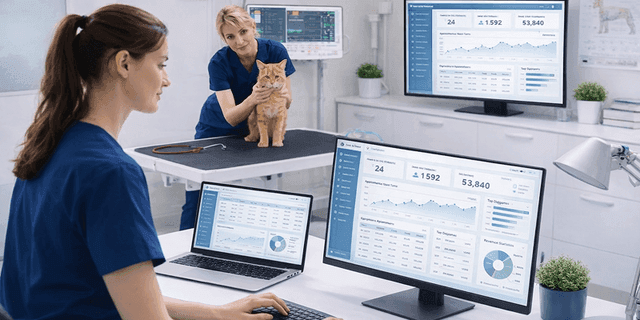
The shift isn’t happening because clinics want new technology. It’s happening because the current way of working no longer fits the pace of modern practice. Veterinary clinics today handle more patients, more communication channels, and more expectations from pet owners than ever before. At the same time, teams are expected to stay efficient, accurate, and responsive.
Cloud-based veterinary software started gaining traction not as a trend, but as a response to these pressures. It allows systems to be accessible anywhere, updated continuously, and more adaptable to how clinics actually operate. The move toward a cloud-based vet management system is less about innovation and more about alignment, bringing software closer to real workflows.
What Is a Veterinary Practice Management Platform?
A veterinary practice management platform is the system that holds together the operational and clinical sides of a clinic. It manages appointments, patient records, billing, communication, and reporting, all within a single environment.
But the definition alone doesn’t capture what matters. The real role of a modern PIMS is to reduce the gap between clinical work and documentation. It should support how veterinarians think and move during a consultation, not slow them down. For a fuller answer to what a veterinary PIMS is, who makes them and what they cost, see our guide.
What to Look for in Cloud-Based Veterinary Practice Management Software
Evaluating PIMS options requires looking past the feature checklist. Every platform today offers scheduling, medical records, billing, and inventory. The differences that actually matter are:
• AI depth — Does the AI go beyond transcription? Clinical decision support (medication safety checks, breed-specific risk alerts, drug interaction flagging) is the emerging differentiator in 2026. Most platforms offer documentation of AI. Very few offer clinical intelligence.
• Workflow fit — Does documentation happen at the point of care, or does it pile up for later? A system that slows down the exam room defeats its own purpose.
• Integrated billing — Charges should generate automatically from the medical record, not require a separate billing step. Disconnected billing is one of the primary sources of missed revenue in veterinary practices.
• Client communication tools — Two-way messaging, automated reminders, and post-visit follow-ups are now expected baseline features. Evaluate how these integrate with the core record, not how they appear in a demo.
• Business intelligence — Clinic owners and managers need visibility into revenue per doctor, appointment conversion rates, and inventory trends. Reporting should be built in, not bolted on.
• Total cost — Monthly license fees rarely reflect real cost. Factor in onboarding, data migration, training, and integration fees before comparing sticker prices.
For a structured walkthrough of the full decision framework, see: How to Choose Veterinary Practice Management Software.
Core Features Every Modern PIMS Should Include
At a minimum, clinics expect scheduling, medical records, billing, and inventory management. But the best veterinary software today goes much further.
Modern systems typically include AI-assisted documentation, clinical decision support, digital treatment sheets, anesthesia monitoring, integrated payments, business intelligence, workflow management, and client communication tools.
What matters isn’t just having these features — it’s how naturally they fit into the day. The more the system aligns with real clinical flow, the less it feels like something separate that needs to be “used.”
How Cloud-Based Systems Actually Work
Unlike traditional setups, a cloud-based veterinary practice management software doesn’t rely on a single local server. Data is stored securely online, which allows access from different devices and locations. Updates happen automatically, and clinics don’t need to manage infrastructure themselves.
This shift changes not just where the software runs, but how it’s used — making it more accessible during and after consultations, and removing the IT overhead that server-based systems require.

Cloud-Based vs On-Premise Veterinary Systems
For many clinics, choosing veterinary practice management software is no longer just about features — it’s about how the system fits into daily operations.
Traditional on-premise systems still offer a sense of control, but they often come with hidden limitations: restricted access to a single location, ongoing maintenance, manual updates, and difficulty scaling as the clinic grows. These constraints tend to surface during the busiest moments, when quick access to information matters most.
Cloud-based veterinary software takes a different approach. It allows teams to access patient records, manage workflows, and handle communication from any room, device, or location. Updates happen seamlessly, and the system adapts more easily to the pace and complexity of modern clinics.
This shift is one of the key reasons many clinics are re-evaluating their current setup and moving toward more flexible, scalable solutions. For a deeper breakdown of the differences, advantages, and trade-offs, see: Cloud-Based vs Traditional Veterinary Software.
Key Use Cases in Modern Veterinary Clinics
The impact of veterinary practice management software becomes clearer when you look at how it’s used day to day.
Appointment & Workflow Management
Schedules may look structured, but real clinic days rarely are. Delays, emergencies, and walk-ins constantly reshape the flow. A modern system helps teams adjust without losing track of patients or priorities.
Medical Records & Documentation
There’s a moment after every consultation where the room is empty, but the work isn’t finished yet. Documentation follows every patient, whether there’s time for it or not. The role of the system is to make that process faster and more natural — ideally capturing notes at the point of care rather than queuing them for end-of-day.
Billing, Payments, and Inventory
Financial workflows often run in parallel with clinical care. When disconnected, they create extra steps and errors. Integrated systems help reduce duplication and keep everything aligned — charges generate from the record, not from a separate billing step.
Communication with Pet Owners
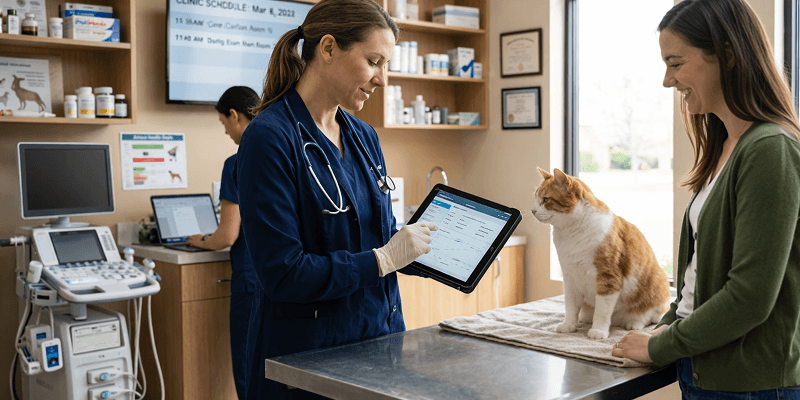
Follow-ups, reminders, and updates are now expected, not optional. Software plays a growing role in maintaining consistent communication without adding manual workload. The best platforms embed client communication directly into the clinical workflow rather than treating it as a separate module.
Multi-Location Coordination
As clinics expand, coordination becomes more complex. Shared access to records and standardized workflows allow teams across locations to stay aligned — a capability that server-based systems handle poorly and cloud platforms handle natively.
How Different Clinics Choose the Right Software
Not all clinics operate the same way, and that directly shapes how they evaluate veterinary practice management software. What works for a single-doctor clinic handling a steady flow of appointments may not work for a growing practice managing multiple vets, higher patient volume, and more complex coordination.
Independent Clinics and Small Practices
In smaller clinics, every extra step is noticeable. There’s less room for inefficiency, and systems that feel heavy or overly complex tend to slow things down quickly. These teams usually look for simplicity, speed, and ease of use. The software needs to support fast documentation, clear scheduling, and straightforward workflows without requiring constant navigation or training.
Growing and Multi-Location Veterinary Groups
As clinics expand, the challenges shift. It’s no longer just about individual efficiency — it’s about consistency across teams, visibility across locations, and the ability to manage operations at scale. Multi-location practices need systems that standardize workflows, centralize data, and allow different teams to stay aligned without creating bottlenecks.
Specialty and Emergency Clinics
Emergency and specialty clinics have fundamentally different requirements than GP practices. High-acuity environments need real-time treatment sheets, anesthesia monitoring integrations, and critical care documentation workflows that general-purpose PIMS weren’t built for. Platforms designed for GP practices will feel underpowered in an emergency setting — specialty clinics should evaluate purpose-built options separately from the general market.
If you’re actively comparing platforms right now, we’ve ranked and reviewed the top veterinary PIMS options for 2026 — including how each performs on AI depth, workflow fit, and practice size. See the full comparison of the top veterinary PIMS options for 2026.
Benefits of Cloud-Based Veterinary Software
The benefits are rarely about technology alone. They show up in how the clinic feels at the end of the day, how smoothly things move, how much is left unfinished, and how much effort it takes to keep everything aligned.
Speed and Workflow Efficiency
When systems are designed around real workflows, documentation becomes quicker and less disruptive. Fewer clicks and better structure mean clinicians can move from one case to the next without constantly breaking their focus.
Over time, this reduces the quiet backlog that tends to build throughout the day.
Accessibility and Remote Access
Cloud-based systems allow teams to access records from anywhere in the clinic, or even outside of it when needed. Whether it’s checking a patient history or updating notes, information is no longer tied to a single workstation. This flexibility becomes especially important during busy hours or when multiple team members need access at the same time.
Data Security and Compliance
A secure veterinary SaaS environment ensures that patient data is protected through encryption, controlled access, and regular system updates. Unlike local systems, security improvements happen continuously without requiring manual intervention. Modern cloud platforms typically maintain security standards that exceed what independent clinics can achieve on local servers.
Scalability for Growth
As clinics grow, their operational needs become more complex. Cloud-based veterinary software allows practices to expand, adding users, locations, or services, without needing to rebuild their infrastructure. This makes it easier to scale without disrupting daily operations.
Reduced IT Overhead
Maintaining servers, handling backups, and managing updates can take time and resources that clinics would rather use elsewhere. Cloud systems remove much of that responsibility, as updates and maintenance are handled in the background. This allows teams to stay focused on patient care instead of technical management.

Challenges Clinics Should Consider Before Switching
Even when the benefits are clear, switching veterinary practice management software is rarely a frictionless process. Clinics are not just changing a tool — they are adjusting workflows, habits, and sometimes even how teams communicate throughout the day.
-
Data Migration — Transferring existing patient records, histories, and financial data requires accuracy and structured planning to prevent data loss or inconsistencies. Ask vendors specifically how they handle migration from your current system.
-
Staff Adaptation — Every new system introduces a learning curve. Teams need time to adjust to new workflows and interfaces. Practices that invest in proper onboarding consistently report higher satisfaction and faster time-to-value than those who self-onboard.
-
Internet Dependency — Cloud-based systems rely on stable connectivity, which means clinics need reliable internet access to ensure uninterrupted operations. Most platforms offer offline modes for critical functions, but this varies significantly by vendor.
-
Evaluating Security and Reliability — Not all platforms offer the same level of protection. Ask specifically about data residency, backup frequency, recovery time, access logging, and what happens to your data if you cancel your contract.
Practices still on server-based systems often underestimate what staying actually costs — in IT maintenance, staff workarounds, and missed efficiency gains. For a full breakdown of what outdated PIMS is actually costing your clinic, see: The Hidden Costs of Legacy Veterinary Software.
Best Cloud-Based Veterinary Software Options in 2026
The market has grown significantly over the past two years, and “cloud-based” no longer describes a single tier of capability. Platforms now split across three meaningful categories: general-purpose cloud PIMS, AI-native clinical platforms, and specialty/enterprise systems.
The most important differentiator in 2026 is not whether a platform uses AI — they all claim to. It’s what the AI actually does. Documentation tools (scribes) speed up record-keeping. Clinical AI agents surface medication safety checks, breed-specific risk alerts, and lab pattern flags in real time. The gap between these two categories is significant, and it’s where platform selection decisions increasingly turn.
For a full breakdown of how the leading platforms compare — including Bittsi, Shepherd, Digitail, ezyVet, Instinct, and others — see the complete 2026 PIMS comparison.
What Modern Clinics Expect from Their Software Today
Expectations have shifted from “Does it work?” to “Does it fit how we work?” Clinics are no longer just looking for systems that store information. They’re looking for systems that reduce friction, support real-time workflows, and adapt to different working styles.
The definition of a modern PIMS is no longer about features alone — it’s about how naturally those features fit into the day. And for a growing segment of the market, it’s about whether the software contributes to clinical outcomes, not just clinical records.
Where Platforms Like Bittsi Fit Into This Evolution
As veterinary software evolves, newer platforms are being built with a different starting point. Instead of designing around data entry, they focus on clinical flow — how information is created, used, and updated during real consultations.
Bittsi is built around a clinical AI agent — Sage — that operates differently from the transcription tools most platforms call “AI.” Rather than opening a separate drug reference or manually cross-checking a patient’s history, Sage surfaces medication safety checks, breed-specific risk alerts, toxicology flags, and lab pattern signals contextually during the exam. The result is documentation that reflects what actually happened — and a clinical layer that helps prevent errors before they occur.
For practices switching from Avimark, Cornerstone, or another legacy system, Bittsi is designed to be a genuine leap forward — not just a cloud version of what you already had.
See how it works in a 20-minute demo: Book a demo.
Comments
0 CommentFAQ
More from Veterinary Practice Management software.
The Hidden Costs of Legacy Veterinary Software
Legacy veterinary software often creates hidden workflow inefficiencies, manual work, and costly delays — see what your clinic could be missing.
Best Veterinary Practice Management Software (2026 Rankings)
Not all veterinary PIMS are equal. We ranked the top platforms on AI depth, workflow fit, and real clinic outcomes — so you can choose with confidence.
Top 20 Veterinary Influencers in 2026 Driving the Future of Animal Health
A curated, grouped list of the most influential veterinarians on TikTok and Instagram in 2026 — what they cover, who they reach, and why it matters for the profession.
One short read · every Friday · from working clinics.
Workflow notes, what's actually changing in practice, and one good link from the week. No marketing, no upsells. Unsubscribe whenever.